Since 2005, my favorite show on television has been Supernatural. It ran for 15 seasons and 327 episodes, finally finishing in fall 2020. I missed most of the last season (which ran at the height of Covid), but recorded it. Slow to return to watching, I lost the episodes when the AT&T repairman updated our DirectTV and deleted them. I got them again thanks to TNT network, which runs Supernatural in syndication–but had to wait for the final season to cycle around again. Last night I stayed up till 2:30 AM and watched the final four episodes. And since I spent so many years invested in the show, I decided to provide my take on it.
The show started with brothers Sam and Dean Winchester as monster hunters, weekly taking down supernatural threats which proved all-too-real: vampires, werewolves, shape-shifters, wendigos, witches, etc. Very soon demons were introduced, and then in season four angels. As the years went on, the Winchester brothers, their extended family, and a host of hunter allies (American and foreign) found their enemies ramped up, to a cosmic scale. Leviathans, the Four Horsemen, Reapers, Death–and finally God Himself, a potent but petty deity who frankly enjoyed being a puppeteer and watching his creations, especially Sam and Dean, twist in the wind.
The show could be deadly serious, but also funny as hell. Sometimes in the same episode. In one an archangel made the brothers live the same day over and over (as Dean once said, “angels are dicks”), and Dean died a different way each day. Once by having a piano fall on him. The Winchesters also often impersonated FBI agents, using names like “Plant and Page” or “Hamill and Ford.” But entire episodes could be funny, like “ScoobyNatural,” which had Sam, Dean and their angel friend Castiel sucked into an episode of Scooby Doo, where they helped the Scooby gang fight a ghost and in which Dean’s attempts to hit on Daphne failed miserably. But quite often Supernatural was somber, bordering on grave (pun intended).
The acting was top notch. Jensen Ackles as Dean and Jared Padelecki as Sam were amazing. But also Misha Collins as angel Castiel, Jim Beaver as surly, surrogate father Bobby Singer, Mark Pellegrino as Lucifer, Mark Sheppard as demon Crowley, Rob Benedict as Chuck/God, and Richard Speight Jr. as angel Gabriel/Loki (he also directed a number of episodes). Boomers like me also appreciated the regular usage of classic rock in the show: Bob Seger, AC/DC (“Highway to Hell,” of course!), Ted Nugent, Aerosmith, Metallica, to name just a few. (Although they did mellow it up a bit at least once, with Gordon Lightfoot’s “Sundown.”) Most notably Kansas’ “Carry on My Wayward Son,” which for 14 of 15 seasons played during each finale episode. The characters (at least the main ones) were fleshed out and you actually cared about them. The writing and dialogue were also uniformly excellent, once the show hit its stride in season three.
I have two overwhelmingly favorite episodes. “Jus in Bello,” in which Sam and Dean are arrested by an FBI agent who thinks they’re killers making up stories about monsters–until the jail where they’re being held is besieged by a horde of possessed people. The brothers are let out of their jail cell and help law enforcement hold off the demoniacs–until Sam and Dean leave, whereupon a powerful demon shows up and kills the survivors. The other is “Hammer of the Gods,” which sees the Winchesters kidnapped by a bunch of pagan gods–Graeco-Roman, Norse, Hindu–hiding out in a hotel and trying to figure out a way to stop the (pseudo-Christian) Apocalypse. The “gods” decide to try and fight, Kali opining that it’s “Western arrogance” that their God (and devil) cannot be defeated. Sam and Dean agree to help them, but Lucifer shows up and kills all the old gods, after telling them “You’re such…petty little things. Always fighting, always happy to sell out your own kind. No wonder you forfeited this planet to us.” Fortunately for the Winchesters, another angel, Gabriel, had showed up and transported them to safety.
Supernatural was entertaining, thoughtful, scary, poignant, and often funny. No wonder it has one of the most dedicated fanbases in TV history; one which the writers and cast pointedly recognized, and even incorporated. But it was decidedly NOT Christian. The show’s “God” is more like a Platonic demiurge. He created this universe, as well as multiple others, but–as even Lucifer says–he “has no love to give.” He cares nothing at all for his creation, even the sentient beings. They’re just for his amusement. Oh, and God has a sister, Amara, who usually opposes him. The archangels Michael and Lucifer are God’s “sons,” with the latter being the senior. As for Jesus, well, despite the many times we see churches with crucifixes, “he was just a man”–as one character tells an overtly Christian truck driver. Of course, if Christ were presented as He actually is–THE Son of God, Second Person of the Trinity, conqueror of Satan–then the show’s whole cosmic mythology would go up in smoke. And making it overtly Christian would no doubt have driven away legions of atheist and agnostic fans, for whom that would have been a belief too far.
In the penultimate episode, the brothers, helped by their good friend Jack–the powerful son of Lucifer, raised by the Winchesters and Castiel–defeat God, strip him of his powers, and install Jack as the new deity, who then proclaims “people won’t need to pray to me or sacrifice to me. They just need to know that I’m already a part of them, to trust in that. I won’t be hands-on. [God] wrote himself into the story, and that was his mistake.” Humans will have to create the meaning in their lives, as well as any virtues like love, honor, loyalty. Each person will have to be his own Űbermensch . In the real world, however, God writing Himself into the story with His Incarnation in Jesus Christ is the greatest positive event in history. And it is the Holy Trinity that determines good and evil. Not us.
Don’t get me wrong–I loved Supernatural. I think it’s one of the greatest shows in TV history. (Except for how the writers killed off Dean in the very final episode. It ranks right down there with the death of Captain Kirk in Star Trek: Generations.)
The RSF logo, with its name on top and, below, the words “Equipped. Swift. Decisive.” Interestingly, this logo no longer has the word “Quds,” “Jerusalem, which the former one sported. (“Emblem of the Rapid Support Forces,” Wikipedia, Public Domain.)
The Mahdi, for those who might not know, is Islam’s primary eschatological figure who will be sent by Allah to conquer the whole world. While more institutionalized in Shi`i Islam, the belief also exists in the larger Sunni world–thanks to a considerable number of hadiths (sayings of Muhammad) which predict his coming. And Sudan was the site of one of the most successful Mahdist movements in history: that of Muhammad Ahmad, who declared himself the Mahdi in 1880 and went on to lead a movement that conquered Sudan before his death in 1885. And which lasted until 1898, when it was destroyed by the British Army.
I do track modern Mahdist irruptions on this site, whenever they occur (see the archives). Sunni Mahdism shows up most often today as the domain of one-off madmen. But sometimes such transform into actual movements. The aforementioned Muhammad Ahmad. And, more recently, that of Juhayman al-Utaybi and his (puppet?) Mahdi, Muhammad al-Qahtani, in 1979 Saudi Arabia. (For more on eschatological rebellions, especially against the Ottoman Empire, see my 2020 book: The COIN of the Islamic Realm: Insurgencies and the Ottoman Empire, 1416-1916.)
Bottom line: while Mahdism has, historically, been prevalent in African Islam, that’s not the ONLY place it occurs; and while it’s often used as a populist-religious means of bolstering a leader’s legitimacy, it also can become a fervent belief. And that’s when Mahdism becomes quite dangerous.
“Muhammad Ahmad.” If only modern wanna-be Mahdis were so striking and dapper. (From “Muhammad Ahmad,” Wikipedia, Public Domain.)
Although I write about many topics on this blog (Shakespeare, science fiction, rock music, Tolkien), as much as possible I focus on eschatology and messianism–mainly Muslim, since my doctoral studies and several subsequent books dealt with that topic.
But Islam’s Mahdi/Twelfth Imam is not the only apocalyptic game in town. Non-Western (and Islam is a Western religion, coming out of Judaism and Christianity, with a little help from Zoroastrianism) cultures have their own brands of beliefs in a supernatural deliverer. My friend Dr. Richard Landes covers some of these in his brilliant work Heavenon Earth. The Varieties of the Millennial Experience (Oxford, 2011). However, I just discovered that Chinese history is rife with examples of such, as well. Matthew Dentice breaks down many of them in a series of “Patheos” posts, such as this one: “Other Themes in Chinese Eschatology.” I had some knowledge of Buddhism’s messianic Maitreya(s). But I had no idea that Taoism and even Confucianism also held doctrines. As near as I can determine (not being an expert in East Asian cultures or religions), the Taoist and Buddhist “messiahs” were more of a religious nature, while the Confucian sect espousing such looked for a “sage-emperor” who would usher in a political golden age. These beliefs became especially prominent during, and after, the Han Dynasty (202 BC-220 AD).
Thus, the Taiping Uprising (1850-1864), which killed at least 20 million Chinese, might not be solely attributable to Christianity, as it’s usually presented. It very possibly had deeper roots in Chinese society, which Hong Xiuquan bloodily tapped into. And the Communist rulers of modern China might not just fear the “foreign religions” of Christianity or Islam; they probably know full well their own civilization’s millennia-long history of having to deal with intrinsic apocalyptic insurrections.
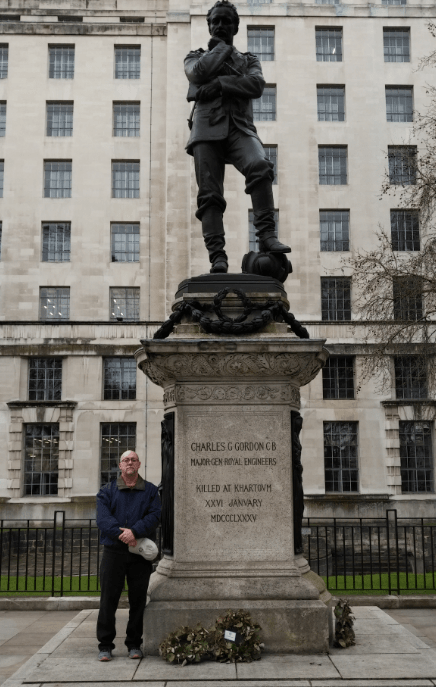
There was one man who dealt with both Chinese and Islamic messianic movements. Major-General Charles Gordon, who died defending Khartoum from the forces of the Sudanese Mahdi Muhammad Ahmad, had earlier in his career helped the Qing rulers put down the apocalyptic Taiping cultists.
Yours truly honoring General Gordon, London, 2019.
To kick off 2024, I could write about the Kuwaiti woman who, a few months, publicly proclaimed herself the Mahdi. I could write about that. But instead, I’m going to cover something more personal. I’ve been fascinated, both positively and negatively, by demonic possession and exorcism since I saw The Exorcist in the 1970s. Yes, I know C.S. Lewis’ warning about demons: disbelieving in them, but also being too interested in them. Nonetheless, I’ve read a lot on the topic and even wrote a paper on it in seminary, years ago.
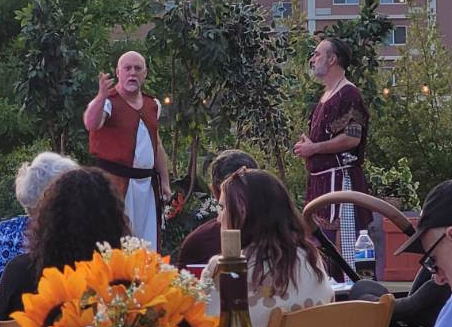
Thus, it was a bit strange that, in 2023, two contexts in which I found myself both, totally unexpectedly, referenced exorcism. First, in June I played several roles in the Rome (Georgia) Shakespeare Festival’s production of Julius Caesar. One was as Caius Ligarius, one of the plotters against Caesar. As that character, I told Brutus (chief plotter, and protagonist of the play) “Thou, like an exorcist, hast conjured up my mortified spirit.”
Then, in September, I took a stage acting class and was assigned the part of George in Who’s Afraid of Virginia Woolf? Act 3 thereof is titled “The Exorcism,” wherein George finally (attempts to) break he and Martha’s marriage free of the devilish lies they’ve been living by for years.
When I auditioned for Julius Caesar, and signed up for that acting class, I had no idea exorcism was mentioned so prominently in both.
This site is billed as focusing on “culture, geopolitics and religion–particularly Islamic eschatology.” Since my last half-dozen posts have been on that latter topic, I thought I’d throw some (Western) culture back into the mix; specifically, Shakespeare.
In the last 15 months, I’ve published five articles on the Bard over at The Stream:
Check these out. As I caveatted in one of the above articles, I’m just a history PhD and amateur thespian masquerading as a Shakespeare analyst. But at least I don’t subject you to any post-modern drivel. (Except insofar as to critique it.)
Yours truly during summer 2022 rehearsals for Henry IV Part 1.
[The title quote is from Othello, Act III, Scene 1.]
Back in 2008, on my old website, I posted a Q & A with the leader of a (then) new Mahdist group in Iraq, one Sayyid al-Yamani–also known as Ahmad al-Hasan. His Ansar al-Mahdi, “Supporters of the Mahdi,” believed that al-Hasan was the son of the out-of-occultation Twelfth Imam (although they were a bit vague on the details). Well, that group has now evolved into the “Ahmadi Religion of Peace and Light” (not to be confused with the much larger Ahmadiyya community–which dates from the 19th century, and also believes its founder was the Mahdi, as well as the returned Jesus). Its leader is Ahmad al-Hasan’s son, Abdullah Hashem Aba al-Sadiq, whom they refer to as the “second Mahdi.”
These folks are syncretistic (every major prophet and thinker is history is revered), oh-so-progressive, and even open to those of the LGBTQ persuasion. Those sorts of beliefs, coupled with their overt Mahdism, makes them a target for mainstream, especially Sunni, Muslims. And that’s what happening in Turkey. A hundred or so of them have been detained in Turkey, trying to get into Europe via Bulgaria. Some report being held in horrible conditions, and even abuse. Members are said to have come from Thailand, Jordan, Iran, Iraq, Algeria, Azerbaijan and the Palestinian territories. Their leader is said to have been raised in Egypt. On the website of a Western follower, al-Sadiq is shown wearing a toboggan cap pulled down over his eyes, sporting a close-cropped beard and stylishly clad in black. He published a book on the group’s teachings in 2022, which include reincarnation and that these are the end times.
Screenshot from the Ahmadi Religion of Peace and Light website.
If a more belligerent Mahdi is your cup of tea, then the latest news out of Iran should thrill you. Last month, Professor Gholamreza Qasemian, “director of the Majlis [Parliament] library, museum, and archives and expert in religion for Iran’s broadcasting” had some interesting public comments. “Israel only has three years left to exist. There is even no need for a war….[it] will self-destruct.” And so the Islamic Republic’s main enemy will not be the Jewish state. “Who will we face at the final war? The Hejaz, Saudi Arabia, which is the America of the Arabian Peninsula. This will lead to the conquest of the main Qibla [the direction facing the Ka`abah in Mecca] and the Hidden Imam will reappear there.” Qasemian also opined that “since they know this, they have snipers all around the Masjid al-Haram” [the Sacred Mosque of Mecca]. I wonder if it takes some kind of magic bullet to kill the Mahdi? Those snipers better hope they don’t miss. Because if they do, the Twelfth Imam will probably wreak a terrible vengeance.
These quite different Islamic messianic figures stand at the two opposite poles of Twelver Shi`i eschatology. The latter view presented has the advantage of being supported by a rich and powerful nation (which just got richer, thanks to Joe Biden). That of Abdullah Hashem Aba al-Sadiq seems destined to fail. But since it’s much more in tune with the zeitgeist, perhaps not. Time will tell.
We Christians, looking at the Ahmadis’ one-size-fits-all messianism, might be forgiven for seeing hints of Antichrist. Especially their claim that al-Sadiq’s teachings constitute a “new Gospel.” St. Paul warned “even if we, or an angel from heaven, should preach a gospel other than the one we preached to you, let them be under God’s curse” (Galatians 1:8).
Russia’s #2 man, Dmitry Medvedev (currently Security Council Deputy Chairman; former PM and President), has been waxing eschatological lately. Last year he warned that the horsemen of the Apocalypse might well be riding out (by the way, Newsweek: why do you capitalize “New Testament” but not “bible?”); and he stated that Russia’s war in Ukraine is part of its struggle against Satan. Last week he doubled down, claiming that “the prophecies of the Apocalypse are getting closer.” This echoes, albeit in more overtly Christian language, what Numero Uno Vladimir Putin says. Whether these two men are true believing Orthodox Christians, or deceptive opportunists, is debatable. (Although why couldn’t they be both?) But when the chaps in charge of the world’s largest nuclear arsenal talk like this, we need to take them seriously–not scoff at their beliefs (a phenomenon about which I was interviewed two weeks ago). The folks in our government and media who do so are making the same arrogant mistake they do with Islam and Muslims: “REAL Muslims (or Christians) wouldn’t believe or act like that. Those religions are PEACEFUL.” Can such types be any more ignorant, willfully or not, of religions in history?
“Ragnarök,” Wikipedia (Public Domain). Maybe Hela is the Sixth Horseman, er, Horsewoman?
Speaking of the world’s second-largest religion, there’s End Times news on that front, too. In Gujarat, India, some Muslims have been arrested for “targeting interfaith individuals” by “intercepting the couple” and then “thrash[ing] them in the name of moral policing”–after which they would upload the videos thereof to social media. This group called themselves the “Army of Mahdi.”
Of course, it could be a lot worse than just some “thrashing.” Mainstream Sunni and Shi`i commentators on the End Times believe that the Mahdi and Jesus (who returns as a Muslim) will give non-Muslims the Hobson’s choice of conversion or death. (When I attended a Mahdism conference in Iran in 2008, I sat through an entire panel on this topic. I refrained from commenting during, however.) The Mahdi may as well mount up and ride out with the Four Horsemen, then.
Russia’s Orthodox Christian leadership is simply warning about the intersection of geopolitics and their faith’s eschatological elements. Some Muslim leaders, however, especially in Iran, do seem to want to get the End Times timer counting down. It remains to be seen whether you can hotwire a horse.





 The Occidental Jihadist


