Seventeen years ago I was writing posts over at my old site Mahdiwatch about an Iraqi Shi`i Mahdist movement centered around one Ahmad al-Yamani. I even interviewed him virtually at one point, although I have since lost the notes. As near as I could ascertain, al-Yamani was claiming to be a representative, or herald, of the coming 12th Imam al-Mahdi–sort of a John the Baptist figure, mutatis mutandis. He also said that his movement was peaceful, although even then the Iraqi government alleged his followers were actually violent.
His Ansar al-Mahdi had not been heard from much in the intervening years. But two days ago, Shafaq News (an Iraqi, pro-Kurdish site) reported that Ahmad bin Hasan al-Yamani, “a senior leader of the Al-Yamani Movement in Najaf province” had been arrested. He was described as “the chief strategist behind the group, which has called for attacks on top religious figures.” Al-Yamani “had evaded capture for years.” The article went on to state, confusingly, that al-Yamani had claimed BOTH to be the “deputy of the Mahdi” AND “the first of twelve Mahdis who follow the twelve Imams.”
In mainstream Twelver Shi`ism "al-Yamani" (the Yemeni) is indeed an eschatology-adjacent figure who comes from Yemen and prepares Muslims for the arrival of the actual Mahdi, the End Times leader who will, along with the returned Muslim Jesus, bring the whole world under the sway of Islam. (This bit in the article about 12 Mahdis makes no sense. In Twelver Shi`ism, the the 12 Imams are descendants of Muhammad through Ali’s line, the final one of which will be the eschatological Mahdi. There are not 12 Mahdis in this branch of Islam.)
Mahdism has been a hugely potent strain in the world’s second-largest religion for over a millennium, as I outlined in this article (and in several of my books). Men claiming to be the Mahdi are often a thorn in the side of established rulers–as al-Yamani appears to be for Baghdad. Perhaps his followers were violent; or the Iraqi government simply needed to put him away, as a political and religious irritant, and ginned up accounts of planned assassinations. But arresting such figures is usually insufficient to stop their movements, as the Mahdist imperative is deeply embedded in both Shi`i and Sunni Islam and serves as a powerful tool for combating perceived unjust rulers.
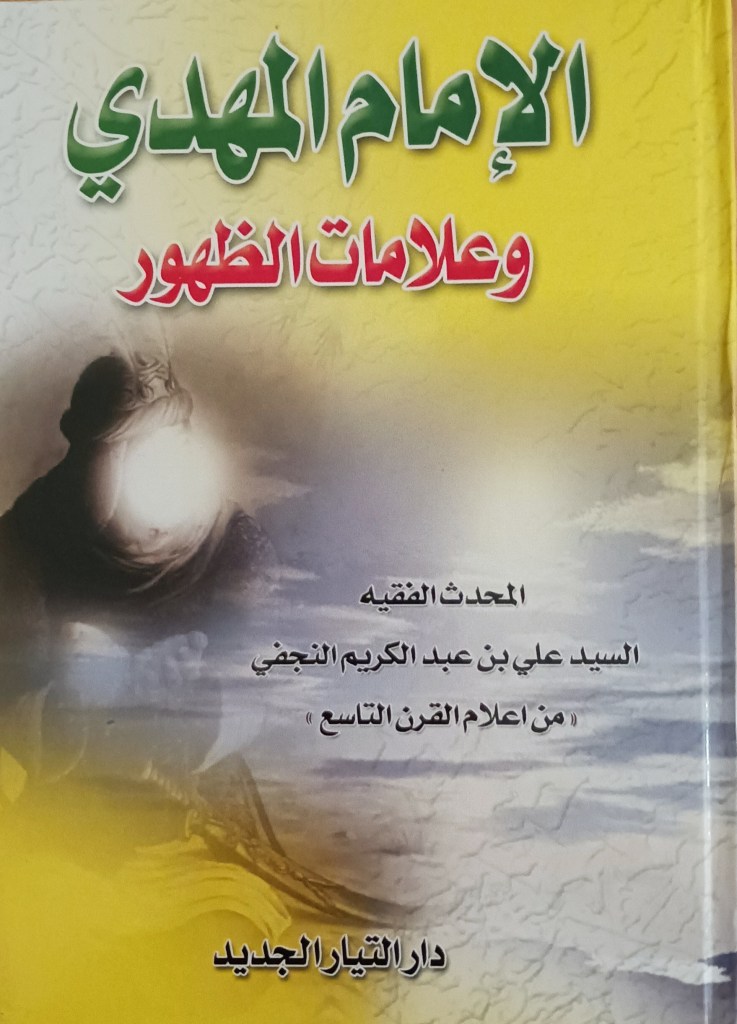
Imam Mahdi and Signs of the Appearance: one of my many Arabic books on this topic.
Terrorists run rampant in the modern world, from al-Qa`idah to Sendero Luminoso. Most (78%, according to our own State Department list) are Islamic. The US has never really devised a coherent, consistent counter-terrorism policy for dealing with such–in part because many of these movements qualify as Muslim insurgencies, which require a different analytical lens and counter. The Ottoman Empire, for half a millennium, was beset by such problems. (Ditto for its successor state, the Turkish Republic.) I wrote an entire book on this topic, which our policy makers NEED to consult. So I’ll make it easier for them by posting, below, the interview which the analytical shop Wikistrat did with me on this topic.
Precis: Some major observations which I hope folks can take from this book are that there is really little, if nothing, new under the sun in terms of Islamic insurgencies; that the Ottoman Sultans faced opposition very much like today’s ISIS and AQ; that Ottoman COIN was as much ideological as kinetic, needing not just steel and hunger (as Julius Caesar said) to defeat rebels, but ink—for fatwas; and that Mahdism (Islamic messianism) “was perhaps the most potent, and prevalent, type of insurgency” (p. 280).
Wikistrat–Sep 25, 2020 (Updated: Sep 20, 2023)
Wikistrat: You mention you are a historian of the Islamic world, not the Ottoman Empire specifically. What compelled you to write this book, and what do you hope our experts in Wikistrat’s ME community will come away with?
TF: I studied the Ottomans at some length, as well as the Ottoman Turkish language, in my doctoral work at Ohio State. So, while I ultimately specialized in eschatological movements across space and time, using Arabic sources, I retained a keen interest in the Ottoman Empire. In recent years I have worked at US Special Operations Command, where I became familiar with the field of counter-terrorism and counter-insurgency (COIN); in addition, I have taught history of terrorism, and military history, at Reinhardt University in Georgia. Both experiences showed me that US analysts and policymakers rarely look beyond Western examples of COIN: Rome, Napoleon, the Brits, or Americans in Vietnam, Iraq, Afghanistan. There are a few non-Western studies—on the Egyptians in Yemen in the 1960s, for example—but I could only find one on the Ottoman experience, and that just during World War I. This struck me, considering that I knew the Ottoman Empire faced many insurgencies in its half-millennium of rule in the Middle East, Southeast Europe, and northeast Africa. So, since Ottoman historians are generally ignorant of unconventional warfare, and the chaps at SOCOM don’t know much about the Ottomans, I decided to do what I could to bridge a gap in the scholarship.
Some major observations which I hope folks can take from this book are that there is really little, if nothing, new under the sun in terms of Islamic insurgencies; that the Ottoman Sultans faced opposition very much like today’s ISIS and AQ; that Ottoman COIN was as much ideological as kinetic, needing not just steel and hunger (as Julius Caesar said) to defeat rebels, but ink—for fatwas; and that Mahdism (Islamic messianism) “was perhaps the most potent, and prevalent, type of insurgency” (p. 280). In fact, chapter four is my counter-example one, wherein I look at the medieval North African Almoravid (al-Murabitun) state, which was challenged and ultimately overthrown by the Almohad (al-Muwahhidun) Mahdists. I analyze why the Almoravids failed when the Ottomans succeeded.
Wikistrat: Your target audience is military and government professionals who study warfare and COIN (counter-insurgency), as well as the general public. What events or processes in the long and fascinating history of the Ottoman Empire stand as out as most relevant to your intended audience?
TF: I examine seven primary insurgencies against the Empire across space and time: Sufis, Celalis, Kadizadelis, Druzes, Zaydis, Wahhabis, and Sudanese Mahdists. Six of those were based in Islam itself or in a heterodox/heretical movement thereof (the Celalis, basically disgruntled soldiers, are the lone exception). I consider the Kadizadelis, Zaydis, Wahhabis, and Sudanese Mahdists the most relevant to the modern world. Kadizadelis were 17th century Ottoman Islamic fundamentalists, who hoped to change the system sans violence. They thus resemble, for example, today’s Hizb al-Tahrir or Muslim Brotherhood. The Zaydis of Yemen fought imperial control because they detested both foreign and Sunni rule. The Zaydis are still fighting the same two-pronged struggle.
The Wahhabis have their own state now—the Kingdom of Saudi Arabia—but have spawned their own problematic offshoots in the guise of ISIS, AQ, and similar groups. And the same eschatology which drove Muhammad Ahmad in 19th century Sudan to declare himself the Mahdi is at work in a number of places in the Islamic world—most overtly ISIS, but also in Turkey where, just last year, a senior advisor to President Erdogan was fired for stating publicly that his defense contracting company was helping prepare the way for the Mahdi’s coming. And don’t forget that the 1979 attempt to overthrow the Saudis was led by a self-styled Mahdi.
Again, for these four insurgencies, in particular, we see that the Ottomans had already dealt with opposition movements that look very much like what our allies in the Islamic world face today. A modern paradigm provides for four COIN outcomes: insurgent victory, government victory, driving insurgents to turn into criminals/terrorists, or assimilating insurgents back into the system. The Ottomans had experience with all but the third—which, again, can be instructive for today.
Wikistrat: Studying insurgencies against Ottoman rule, particularly the 16th-17th century Druze uprisings, can you draw any parallels with Turkey’s response to internal resistance to Erdogan’s consolidation of power? Or Turkey’s response to Kurdish resistance inside the country and across the border in Syria?
TF: Actually, if I may, I think a better analogy for what’s going on inside Turkey today, in terms of resistance to Erdogan’s rule, would be the Kadizadeli movement. That group did not actually wage jihad against Istanbul, as most of the others did; rather, its adherents tried to change the Ottomans’ favoring of Sufis in imperial administration and to make the government more starkly pious (according to their own standards). With this challenge in particular, the Sultans responded not with shock and awe, as was the default position for other COIN operations, but with what I deemed “shock and law.”
The Diyanet (Turkish Religious Authority) puts out lists of organizations deemed a threat to the Republic, and literature delegitimizing them. Should that prove insufficient, members are arrested. This includes individuals such as Adnan Oktar and would include Fetullah Gülen if the Turkish authorities could pry him out of Pennsylvania. On the other hand, Kurdish groups that have taken up arms against Ankara are treated much as the Ottomans would have any separatist groups—which would not have included the Druzes, who disliked Ottoman taxes but never really tried to break away to create their own Druze state.
Perhaps the Kurds in modern Turkey thus most resemble the Zaydis—not in the brand of Islam (since Kurds are Sunnis), but in that they are a separate ethnolinguistic group chafing under Turkish rule.
Wikistrat: Would you describe Erdogan as neo-Ottoman, and if so, what “Ottoman predilections” in your opinion have reemerged in Turkey’s current government?
TF: I think it’s hyperbolic to refer to him that way. Yes, the Turkish president wants the Republic to be less secular and more Muslim, exemplified by prevailing upon the Turkish legal system to allow Hagia Sophia to function as a mosque again. He also wants to extend Ankara’s influence into the old Ottoman “near abroad.” And he clearly sees Turkey as the leading Islamic nation—not illogically, considering it still retains, to some degree, the Ottoman cachet. But he wins elections, which no Sultan ever did. He and the AK Party are suspicious of Sufism, whereas Sufis were entrenched in the Ottoman government and military. Finally, while seemingly sympathetic to the Muslim Brotherhood on the international scene, Erdogan is not trying to turn Turkey into Saudi Arabia or Iran. He’s probably like to be elected, or proclaimed, caliph—but that would be, for him, more a civilizational than a religious position.
I say in the book that Turkey, even under Erdogan, “remains the most moderate Islamic influence—and thus the one with the most potential to delegitimize Islamic terrorists” (p. 282).
Here are my 66 articles about geopolitics (to include Islam/the Middle East, terrorism/counter-terrorism, foreign and military affairs) published at The Stream in the last few years (out of 153 total). Yes, I use cultural references, some tongue-in-cheek–but embedded in solid analysis of each topic.



 The Occidental Jihadist