My Crusade against (the term) “Islamism”

Back in 2023, I wrote a piece for The Stream entitled “A Jihad on the Term ‘Islamism.'” That article no longer works at the archived site, so I am reposting it here, since so many (even conservatives) need to learn why they should avoid the term.

“A Jihad on the Term ‘Islamism’”—Tim Furnish (2023)

I am hereby declaring a jihad on the word “Islamism.

The term is pervasive. Google it. You’ll get 40 million hits. Over 46 million for one who practices it, an “Islamist.” Writers and analysts of all political persuasions use these terms. Here are some examples from the Right. Dennis PragerKatherine Gorka (wife of Sebastian), the Trump Administration (in its National Security Strategy, no less), Greg Gutfeld, even The Stream. The Left deploys them probably even more frequently. NPRThe AtlanticWaPo/CNN, the Council on Foreign Relations, our deep state, the “Global Media Style Guide on Islam.

Both sides of the aisle can’t be wrong, can they? Actually, yes. Here’s why. Both conservatives and liberals/Leftists use “Islamism” as a way to differentiate political Islam from allegedly mainstream Islam. But Islam is inherently political. More so than any other religion on earth. “Islamism” and “Islamist” disguises that. What’s wrong with that? It allows the world’s second-largest religion plausible deniability for its legions of political activist and revolutionaries. It allows apologists to say “they’ve corrupted Islam.” (Much the same argument as is made regarding jihadists.)

When I was in graduate school at Ohio State in the 1990s, “Islamism” had a narrow meaning. The ideology of late 19th/early 2oth century “Islamic modernists.” Mainly in Egypt and Iran. These activists tried to fuse Western political ideas, like democracy, with the Quran. This approach was one of three to Western imperialism and dominance in the Muslim world.

There were two other reactions. One copied Western secularist governments. The Turkish Republic led the way here. On the other end of the spectrum, fundamentalists rejected Western ideas. They favored the idea of Islam al-hall. “Islam is the solution.” Muslims could fix their society by returning to the Quran and hadiths (collected sayings of Muhammad). And putting those teachings into practice. The Wahhabis of Arabia and Deobandis of India typified this strategy.

Now, a century later, here’s how those three approaches have shaken out. Western-style secular governance is almost dead in the greater Middle East. Even Turkey has been re-Islamized. Fundamentalism is stronger than ever, especially in many Sunni countries and regions. Saudi Arabia, Yemen, Pakistan, Afghanistan, northern Nigeria, Sudan. Anywhere that Islamic law is enforced. So what about “Islamic modernism?” It survived in groups like the Muslim Brotherhood. And Turkey’s ruling AK (“Justice and Development”) party.

But a funny, and unfortunate, thing happened to that former middle way. It’s been assimilated to the fundamentalist Islamic strain. At least politically. This happened to the Muslim Brotherhood decades ago. Now it wants Muslims to institute Islamic rule. As such, the Muslim Brotherhood has the same goal as Islamic State or al-Qa`idah. The only real difference is that the MB officially eschews violent jihad. (And its leaders’ beards tend to be shorter than those of IS or AQ.) Of course, MB’s offshoots like Hamas openly embrace jihad.

Granted, not all transnational Islamic organizations (MB-derived or not) are jihadist. But all share the same goals: more Islam in public life, to include the legal system and government. There are three major organizations in this regard. The MB. Hizb al-Tahrir (HT) dedicated to bringing back the caliphate. And the massive Gülen movement of Turkish Sufism (Islamic mysticism). All are very political.
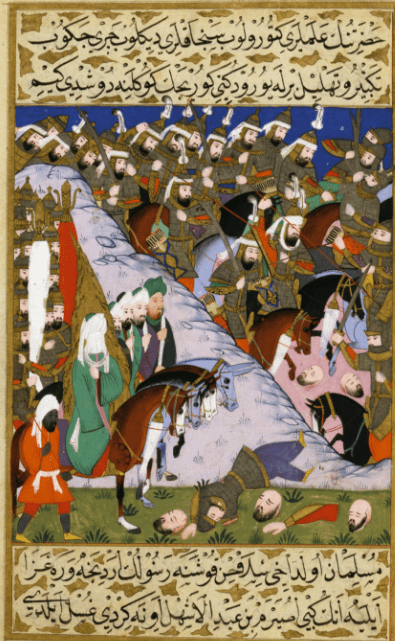
And why wouldn’t they be? Islam is at its very heart political. Much more so than Christianity.

“The Founder of Christianity bade his followers ‘render unto Caesar the things which are Caesar’s, and unto God the things which are God’s.’” (Matthew 22:21) It was not until Roman Emperor Constantine that Christianity became political. On the other hand, “the Founder of Islam was his own Constantine, and founded his own state and empire. … The dichotomy of regnum and sacerdotium, so crucial in the history of Western Christendom, had no equivalent in Islam.” (Bernard Lewis, The Crisis of Islam, p. 6.) Muhammad’s successors, the caliphs, were not just heads of state, but Allah’s deputies. And their main role — or that of any lesser Muslim potentates, such as a sultans — was to extend Islamic rule over all non-Muslims. Bernard Lewis, again: in Islam political authority is a “divine good” (The Political Language of Islam, p. 25) and should be seized at every opportunity. Not something that risked endangering one’s immortal soul, as in Christianity.

The ayatollahs certainly seized their opportunity in 1979 Iran. Scholars often try to claim the Islamic Republic’s governmental and legal systems owe more to the French political theorist Auguste Comte than to the Quran. But the IRI’s staunch Shi`i roots are 500 years deep. And it wasn’t the Frenchman who came up with flogging for cross-dressing, amputation for theft and stoning for adultery. It was Muhammad and his modern epigone, the Ayatollah Khomeini.

The IRI is Islamic political thought in modern Western garb. Ditto for the MB, HT, Gülenists and AK party members. There are no discernible political differences between these five organizations and the 55 Islamic terrorist groups listed by the U.S. State Department. There are disagreements about how, when, and how much to employ jihad in realizing political goals. To what degree, perhaps, the ends justify the means. But the ends of MB and HT are the same as those of IS and AQ. World government under Islamic law, administered by a caliph.

So why pretend otherwise? Which is what referring to such Muslims as “Islamists” does. They’re simply Muslims. And “Islamism” is just fundamentalist Islam. In this case, “thy name well fits thy faith” (Cymbeline, Act V, Scene 2).

The End of Everything “Supernatural”

Since 2005, my favorite show on television has been Supernatural. It ran for 15 seasons and 327 episodes, finally finishing in fall 2020. I missed most of the last season (which ran at the height of Covid), but recorded it. Slow to return to watching, I lost the episodes when the AT&T repairman updated our DirectTV and deleted them. I got them again thanks to TNT network, which runs Supernatural in syndication–but had to wait for the final season to cycle around again. Last night I stayed up till 2:30 AM and watched the final four episodes. And since I spent so many years invested in the show, I decided to provide my take on it.

Image from https://wallpaperaccess.com/supernatural-4k That’s Sam (L) & Dean, for those who don’t know.

The show started with brothers Sam and Dean Winchester as monster hunters, weekly taking down supernatural threats which proved all-too-real: vampires, werewolves, shape-shifters, wendigos, witches, etc. Very soon demons were introduced, and then in season four angels. As the years went on, the Winchester brothers, their extended family, and a host of hunter allies (American and foreign) found their enemies ramped up, to a cosmic scale. Leviathans, the Four Horsemen, Reapers, Death–and finally God Himself, a potent but petty deity who frankly enjoyed being a puppeteer and watching his creations, especially Sam and Dean, twist in the wind.

The show could be deadly serious, but also funny as hell. Sometimes in the same episode. In one an archangel made the brothers live the same day over and over (as Dean once said, “angels are dicks”), and Dean died a different way each day. Once by having a piano fall on him. The Winchesters also often impersonated FBI agents, using names like “Plant and Page” or “Hamill and Ford.” But entire episodes could be funny, like “ScoobyNatural,” which had Sam, Dean and their angel friend Castiel sucked into an episode of Scooby Doo, where they helped the Scooby gang fight a ghost and in which Dean’s attempts to hit on Daphne failed miserably. But quite often Supernatural was somber, bordering on grave (pun intended).

The acting was top notch. Jensen Ackles as Dean and Jared Padelecki as Sam were amazing. But also Misha Collins as angel Castiel, Jim Beaver as surly, surrogate father Bobby Singer, Mark Pellegrino as Lucifer, Mark Sheppard as demon Crowley, Rob Benedict as Chuck/God, and Richard Speight Jr. as angel Gabriel/Loki (he also directed a number of episodes). Boomers like me also appreciated the regular usage of classic rock in the show: Bob Seger, AC/DC (“Highway to Hell,” of course!), Ted Nugent, Aerosmith, Metallica, to name just a few. (Although they did mellow it up a bit at least once, with Gordon Lightfoot’s “Sundown.”) Most notably Kansas’ “Carry on My Wayward Son,” which for 14 of 15 seasons played during each finale episode. The characters (at least the main ones) were fleshed out and you actually cared about them. The writing and dialogue were also uniformly excellent, once the show hit its stride in season three.

I have two overwhelmingly favorite episodes. “Jus in Bello,” in which Sam and Dean are arrested by an FBI agent who thinks they’re killers making up stories about monsters–until the jail where they’re being held is besieged by a horde of possessed people. The brothers are let out of their jail cell and help law enforcement hold off the demoniacs–until Sam and Dean leave, whereupon a powerful demon shows up and kills the survivors. The other is “Hammer of the Gods,” which sees the Winchesters kidnapped by a bunch of pagan gods–Graeco-Roman, Norse, Hindu–hiding out in a hotel and trying to figure out a way to stop the (pseudo-Christian) Apocalypse. The “gods” decide to try and fight, Kali opining that it’s “Western arrogance” that their God (and devil) cannot be defeated. Sam and Dean agree to help them, but Lucifer shows up and kills all the old gods, after telling them “You’re such…petty little things. Always fighting, always happy to sell out your own kind. No wonder you forfeited this planet to us.” Fortunately for the Winchesters, another angel, Gabriel, had showed up and transported them to safety.

Supernatural was entertaining, thoughtful, scary, poignant, and often funny. No wonder it has one of the most dedicated fanbases in TV history; one which the writers and cast pointedly recognized, and even incorporated. But it was decidedly NOT Christian. The show’s “God” is more like a Platonic demiurge. He created this universe, as well as multiple others, but–as even Lucifer says–he “has no love to give.” He cares nothing at all for his creation, even the sentient beings. They’re just for his amusement. Oh, and God has a sister, Amara, who usually opposes him. The archangels Michael and Lucifer are God’s “sons,” with the latter being the senior. As for Jesus, well, despite the many times we see churches with crucifixes, “he was just a man”–as one character tells an overtly Christian truck driver. Of course, if Christ were presented as He actually is–THE Son of God, Second Person of the Trinity, conqueror of Satan–then the show’s whole cosmic mythology would go up in smoke. And making it overtly Christian would no doubt have driven away legions of atheist and agnostic fans, for whom that would have been a belief too far.

In the penultimate episode, the brothers, helped by their good friend Jack–the powerful son of Lucifer, raised by the Winchesters and Castiel–defeat God, strip him of his powers, and install Jack as the new deity, who then proclaims “people won’t need to pray to me or sacrifice to me. They just need to know that I’m already a part of them, to trust in that. I won’t be hands-on. [God] wrote himself into the story, and that was his mistake.” Humans will have to create the meaning in their lives, as well as any virtues like love, honor, loyalty. Each person will have to be his own Űbermensch . In the real world, however, God writing Himself into the story with His Incarnation in Jesus Christ is the greatest positive event in history. And it is the Holy Trinity that determines good and evil. Not us.

Don’t get me wrong–I loved Supernatural. I think it’s one of the greatest shows in TV history. (Except for how the writers killed off Dean in the very final episode. It ranks right down there with the death of Captain Kirk in Star Trek: Generations.)

Just don’t take any of it as Gospel.