Sympathy for the Latest Islamic Devil?

Before starting this website, I ran one called Mahdiwatch. There, way back in 2008, I posted an online “interview” I had done with a group purporting to speak for an Iraqi religious figure named Ahmad al-Hassan, who claimed to be the precursor to the Islamic Mahdi. Three years ago, on this site, I wrote about another chap, Abdullah Hashem Aba al-Sadiq, who maintained that al-Hassan had anointed him (figuratively) as the actual Mahdi. Well, Abdullah Hashem is back in the news. This is according to a long story published yesterday by the BBC, “Religious leader ‘hijacked’ movement, claims brother.” And now he’s taken his Mahdist cult to the UK.

Hashem is the “self-proclaimed Mahdi” who heads up the Ahmadi Religion of Peace and Light (AROPL), now based in a former orphanage in Crewe, Cheshire, UK. (This Islamic offshoot is separate from the Ahmadiyya sect, founded in the late 19th c. in India.) Here is the group’s slick website, which includes a long list of its beliefs. These appear to be an eclectic amalgamation of various Twelver Shi’i and perhaps some Sufi doctrines on the Mahdi/Twelfth Imam, reinterpreted by Hashem.

While the “Mahdi’s” brother, Abdul Rahman (who left the group and lives in Florida), tells the BBC “I don’t think he believes he is the Mahdi,” the British new outlet said that according to the former’s lawyers, it is “false and highly damaging to suggest that Mr Hashem doesn’t believe himself to be the Mahdi.”   What about that supposed imprimatur from Iraq? “The office claiming to represent Ahmad al-Hassan in Iraq told the BBC they denounced Abdullah Hashem….” However, the latter’s lawyers “dispute that the office in Iraq represents the elusive al-Hassan.” Who knew the Mahdi would need so much legal help? One might also wonder how a group with 170 members could afford to buy what appears to be a large compound (per the pictures in the BBC story), in addition to so many lawyers? (Perhaps because, like many cults, its followers “are encouraged to sell their assets when they join.”)

This past spring, the local police raided the AROPL compound “following allegations of sexual offences, forced marriage, and modern slavery made by a former member.” Fourteen people were arrested, although the cult was allowed to continue operating. The BBC story also details the strange and unresolved disappearance of Abdul Rahman’s former wife, who remained in AROPL after their divorce and went missing on a trip to India. Abdul Rahman suspects foul play on the part of his brother’s organization.

How did they wind up in England? Abdullah Hashem himself is Egyptian-American, and started his cult in Cairo. They moved from there to Germany and then Sweden, before the deported from the latter and settling in Crewe. AROPL also filed as a non-profit in the US, and thus seems to plan on expanding its reach here.

While Hashem’s Mahdism borrows from both Twelver Shi’i and Sunni doctrines and hadiths, a number of its teachings run afoul of mainstream Muslim ones: “alcohol is permissible, women don’t have to wear the hijab and the LGBTQ+ community are welcomed.”

Can we see Hashem’s weird religion as a kinder, gentler Islam? Well, I perused some of Hashem’s voluminous teachings, particularly the ones on Jesus. Like mainstream Islam, Hashem denies that Jesus was crucified, rejects that He rose from the dead, and rebuffs the Triune God. (Incidentally, he draws heavily upon Gnostic heresies from the early church to do so.) He’s clearly a type of antichrist, as St. John described (I John 2:22), preaching another “Gospel”—which St. Paul cautioned against (Galatian 1:8). Most importantly, Christ Himself warned us that when He returns it will be obvious to the whole world: “So if anyone tells you, ‘There he is, out in the wilderness,’ do not go out; or, ‘Here he is, in the inner rooms,’ do not believe it. For as lightning that comes from the east is visible even in the west, so will be the coming of the Son of Man” (St. Matthew’s Gospel 24: 26, 27). So the Ahmadi Religion of Peace and Light, while less violent than other Islamic messianic movements in history, is still a false, satanic epigone of the true faith once for all handed to the saints: that Jesus Christ is the Son of God, crucified and resurrected, triumphing over sin, death and the devils.
My Crusade against (the term) “Islamism”

Back in 2023, I wrote a piece for The Stream entitled “A Jihad on the Term ‘Islamism.'” That article no longer works at the archived site, so I am reposting it here, since so many (even conservatives) need to learn why they should avoid the term.

“A Jihad on the Term ‘Islamism’”—Tim Furnish (2023)

I am hereby declaring a jihad on the word “Islamism.

The term is pervasive. Google it. You’ll get 40 million hits. Over 46 million for one who practices it, an “Islamist.” Writers and analysts of all political persuasions use these terms. Here are some examples from the Right. Dennis Prager, Katherine Gorka (wife of Sebastian), the Trump Administration (in its National Security Strategy, no less), Greg Gutfeld, even The Stream. The Left deploys them probably even more frequently. NPR, The Atlantic, WaPo/CNN, the Council on Foreign Relations, our deep state, the “Global Media Style Guide on Islam.

Both sides of the aisle can’t be wrong, can they? Actually, yes. Here’s why. Both conservatives and liberals/Leftists use “Islamism” as a way to differentiate political Islam from allegedly mainstream Islam. But Islam is inherently political. More so than any other religion on earth. “Islamism” and “Islamist” disguises that. What’s wrong with that? It allows the world’s second-largest religion plausible deniability for its legions of political activist and revolutionaries. It allows apologists to say “they’ve corrupted Islam.” (Much the same argument as is made regarding jihadists.)

When I was in graduate school at Ohio State in the 1990s, “Islamism” had a narrow meaning. The ideology of late 19th/early 2oth century “Islamic modernists.” Mainly in Egypt and Iran. These activists tried to fuse Western political ideas, like democracy, with the Quran. This approach was one of three to Western imperialism and dominance in the Muslim world.

There were two other reactions. One copied Western secularist governments. The Turkish Republic led the way here. On the other end of the spectrum, fundamentalists rejected Western ideas. They favored the idea of Islam al-hall. “Islam is the solution.” Muslims could fix their society by returning to the Quran and hadiths (collected sayings of Muhammad). And putting those teachings into practice. The Wahhabis of Arabia and Deobandis of India typified this strategy.

Now, a century later, here’s how those three approaches have shaken out. Western-style secular governance is almost dead in the greater Middle East. Even Turkey has been re-Islamized. Fundamentalism is stronger than ever, especially in many Sunni countries and regions. Saudi Arabia, Yemen, Pakistan, Afghanistan, northern Nigeria, Sudan. Anywhere that Islamic law is enforced. So what about “Islamic modernism?” It survived in groups like the Muslim Brotherhood. And Turkey’s ruling AK (“Justice and Development”) party.

But a funny, and unfortunate, thing happened to that former middle way. It’s been assimilated to the fundamentalist Islamic strain. At least politically. This happened to the Muslim Brotherhood decades ago. Now it wants Muslims to institute Islamic rule. As such, the Muslim Brotherhood has the same goal as Islamic State or al-Qa`idah. The only real difference is that the MB officially eschews violent jihad. (And its leaders’ beards tend to be shorter than those of IS or AQ.) Of course, MB’s offshoots like Hamas openly embrace jihad.

Granted, not all transnational Islamic organizations (MB-derived or not) are jihadist. But all share the same goals: more Islam in public life, to include the legal system and government. There are three major organizations in this regard. The MB. Hizb al-Tahrir (HT) dedicated to bringing back the caliphate. And the massive Gülen movement of Turkish Sufism (Islamic mysticism). All are very political.

And why wouldn’t they be? Islam is at its very heart political. Much more so than Christianity.

“The Founder of Christianity bade his followers ‘render unto Caesar the things which are Caesar’s, and unto God the things which are God’s.’” (Matthew 22:21) It was not until Roman Emperor Constantine that Christianity became political. On the other hand, “the Founder of Islam was his own Constantine, and founded his own state and empire. … The dichotomy of regnum and sacerdotium, so crucial in the history of Western Christendom, had no equivalent in Islam.” (Bernard Lewis, The Crisis of Islam, p. 6.) Muhammad’s successors, the caliphs, were not just heads of state, but Allah’s deputies. And their main role — or that of any lesser Muslim potentates, such as a sultans — was to extend Islamic rule over all non-Muslims. Bernard Lewis, again: in Islam political authority is a “divine good” (The Political Language of Islam, p. 25) and should be seized at every opportunity. Not something that risked endangering one’s immortal soul, as in Christianity.

The ayatollahs certainly seized their opportunity in 1979 Iran. Scholars often try to claim the Islamic Republic’s governmental and legal systems owe more to the French political theorist Auguste Comte than to the Quran. But the IRI’s staunch Shi`i roots are 500 years deep. And it wasn’t the Frenchman who came up with flogging for cross-dressing, amputation for theft and stoning for adultery. It was Muhammad and his modern epigone, the Ayatollah Khomeini.

The IRI is Islamic political thought in modern Western garb. Ditto for the MB, HT, Gülenists and AK party members. There are no discernible political differences between these five organizations and the 55 Islamic terrorist groups listed by the U.S. State Department. There are disagreements about how, when, and how much to employ jihad in realizing political goals. To what degree, perhaps, the ends justify the means. But the ends of MB and HT are the same as those of IS and AQ. World government under Islamic law, administered by a caliph.

So why pretend otherwise? Which is what referring to such Muslims as “Islamists” does. They’re simply Muslims. And “Islamism” is just fundamentalist Islam. In this case, “thy name well fits thy faith” (Cymbeline, Act V, Scene 2).

From Yemen With Hate?

Seventeen years ago I was writing posts over at my old site Mahdiwatch about an Iraqi Shi`i Mahdist movement centered around one Ahmad al-Yamani. I even interviewed him virtually at one point, although I have since lost the notes. As near as I could ascertain, al-Yamani was claiming to be a representative, or herald, of the coming 12th Imam al-Mahdi–sort of a John the Baptist figure, mutatis mutandis. He also said that his movement was peaceful, although even then the Iraqi government alleged his followers were actually violent.

His Ansar al-Mahdi had not been heard from much in the intervening years. But two days ago, Shafaq News (an Iraqi, pro-Kurdish site) reported that Ahmad bin Hasan al-Yamani, “a senior leader of the Al-Yamani Movement in Najaf province” had been arrested. He was described as “the chief strategist behind the group, which has called for attacks on top religious figures.” Al-Yamani “had evaded capture for years.” The article went on to state, confusingly, that al-Yamani had claimed BOTH to be the “deputy of the Mahdi” AND “the first of twelve Mahdis who follow the twelve Imams.”

In mainstream Twelver Shi`ism "al-Yamani" (the Yemeni) is indeed an eschatology-adjacent figure who comes from Yemen and prepares Muslims for the arrival of the actual Mahdi, the End Times leader who will, along with the returned Muslim Jesus, bring the whole world under the sway of Islam. (This bit in the article about 12 Mahdis makes no sense. In Twelver Shi`ism, the the 12 Imams are descendants of Muhammad through Ali’s line, the final one of which will be the eschatological Mahdi. There are not 12 Mahdis in this branch of Islam.)

Mahdism has been a hugely potent strain in the world’s second-largest religion for over a millennium, as I outlined in this article (and in several of my books). Men claiming to be the Mahdi are often a thorn in the side of established rulers–as al-Yamani appears to be for Baghdad. Perhaps his followers were violent; or the Iraqi government simply needed to put him away, as a political and religious irritant, and ginned up accounts of planned assassinations. But arresting such figures is usually insufficient to stop their movements, as the Mahdist imperative is deeply embedded in both Shi`i and Sunni Islam and serves as a powerful tool for combating perceived unjust rulers.

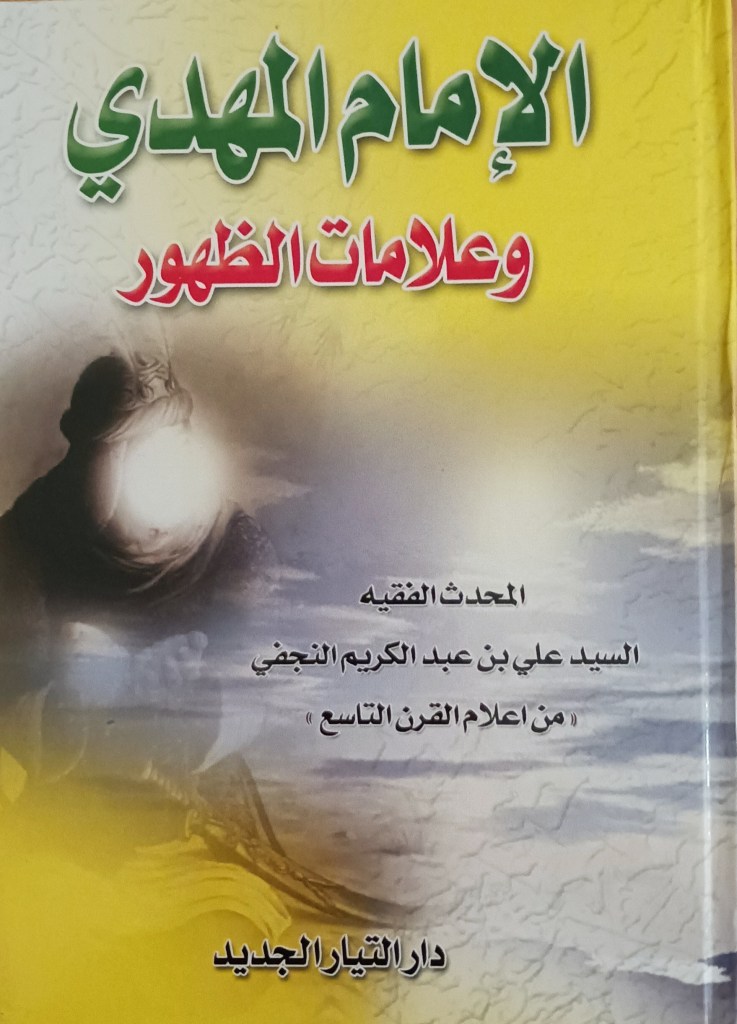
Imam Mahdi and Signs of the Appearance: one of my many Arabic books on this topic.