Nobody’s Fault But Mine…

I haven’t blogged in five months–for two main reasons. First, the “China Virus” hit in the spring, and like many professors I had to move all my classes online–with the extra, unexpected work that that entailed. Second, once the spring university term ended, I committed myself to finally finishing that book on the Ottoman Empire’s counterinsurgency–which I did! It’s now available on Amazon, in both Kindle and paperback versions. And the paperback checks in at 289 pages, available for the reasonable price of $24.99 (while the e-book is only $9.99). If you’re at all interested in Middle Eastern, especially Ottoman, history; counterterrorism, Muslim v. Muslim jihad, and of course Islamic apocalyptic movements–this is the book for you!

From the Middle East to Middle-earth

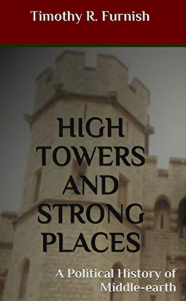
As my periodic posts pulling in Middle-earth politics indicate, I’m a Tolkien fan(atic). Back in 2016 Oloris Publishing put out my intensely-researched book High Towers and Strong Places: A Political History of Middle-earth. But not long after, Oloris ceased operations and High Towers became unavailable except to those as rich as Smaug.

Well, I finally decided to do a hard day’s work–actually, a number of them–and republish the book myself on Amazon. And much of the heavy lifting of editing, as well as all of the formatting, was done by my wife Davina–to whom I owe (yet again) a great deal of thanks.

The book runs to 294 pages (actually 20 more than my doctoral dissertation on Islamic eschatology!) and contains almost 900 endnotes referring to over 200 sources, both primary and secondary. It’s intended for a popular audience, but academic enough to have served as a source (along with the author) for a Master’s degree at Signum University. I am still working on the successor volume: Bright Swords and Glorious Warriors: A Military History of Middle-earth. 

The paperback version is available on Amazon here. The Kindle version should be up soon.

High Towers Cover 2020 Amazon edition paperback

Back cover High Towers 2020


Who’s Your Messiah Now, Netflix?

As some folks who follow my blog probably already know, Netflix recently put out the first season of a show called Messiah. It’s about a modern-day messianic leader who arises in the Middle East, comes to the US and develops a devoted following. I watched all 10 episodes and wrote a lengthy review/analysis of the show, which is available here. (If you do go read it, please be kind enough to leave a comment over the at The Stream. Thanks!)

Jesus and Muhammad Islsamic art

Figure 3. Isaiah’s vision of Jesus riding a donkey and Muhammad riding a camel, al-Biruni, al-Athar al-Baqiyya ‘an al-Qurun al-Khaliyya (Chronology of Ancient Nations), Tabriz, Iran, 1307-8. Edinburgh University Library.EDINBURGH UNIVERSITY LIBRARY–published in “The Koran Does Not Forbid Images of the Prophet” by Christiane Gruber, “Newsweek,” 1.9.15.


Breaking Down “Islamophobia”

As I’ve noted before, I’m privileged to appear periodically on Pete Turner’s excellent radio program, the “Break It Down Show.” Often this is as a commentator for album fights. (And here’s the latest one of those). But every so often Pete gets me on to discuss some aspect of Islamic civilization/history/affairs. This he did again recently, using yours truly as a foil (or actually more of an echo chamber) over against Dr. Boris Havel, a fellow Islam scholar from the University of Zagreb.

The entire show runs about 66 minutes, but it’s worth it!

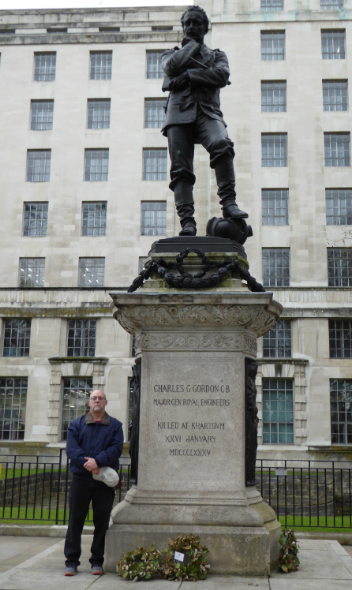
MeandGordon

With one of my Orientalist heroes in London: General

Charles Gordon, killed by Mahdists in Khartoum, 1885.

“Deradicalized” Means Never Having to Say You’re Muslim

At the end of last year, Mr. John Zmirak of “The Stream” put me in contact with Tania Joya, an ex-Muslim and, more notably, ex-ISIS wife. I interviewed her and wrote it up, at length. That piece published yesterday (Saturday, January 11, 2020).  Here’s the link.

Ms. Joya has been interviewed dozens of times.  The vast majority of journalists who did so know little to nothing about Islam. The lone exception was probably Graeme Wood. Mr. Wood, famous for being honest enough to admit that ISIS was (and still is) actually Islamic, does know quite a bit about Islamic theology and how that translates into jihad. (Although he was nine months behind me in figuring this out–see my Sects, Lies, and the Caliphate, pp. 21-31; an essay originally published on my old Mahdiwatch site in June 2014.)

However, Mr. Wood never questions the truth claims and veracity of Islam itself–just its “extremist” groups. In this article I delve into that issue with Ms. Joya. Her conclusion? “If you’re properly deradicalized, you’re not even going to want to be a Muslim.”

Read it all.

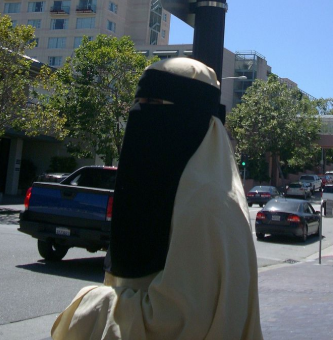
And here’s a photo courtesy of Wikipedia (public domain), “Niqab.”

Niqab Monterey CA

No, it’s not from Yemen, ISIS territory or Iran. It’s from Monterey, California. (Where, incidentally, I learned Arabic at the Army’s Defense Language Institute in the 1980s. I’d be willing to bet this is a relative, perhaps wife, of an Arabic instructor there.)

The Fifth of November & the Eleventh of September

Remember, remember, today is the fifth of November. That means Guy Fawkes is trending on social media. As is V for Vendetta, since many public school products think that the Gunpowder Plot was an anarchist-liberation movement.

Nothing could be further from the truth, as we discuss at some length in the history of terrorism class which I teach. And probably the best recent source on this topic is Marc Nicholls, “Strategy and Motivation in the Gunpowder Plot” from The Historical Journal, 50, 4 (2007), pp. 787-807.

One of the first things Nicholls makes clear is that we should probably be remembering  it as “Robert Catesby Day,” as he was the mastermind of the plot.  Fawkes was (merely) the trigger man, as it were. He had the most military experience of any involved, having fought with the Spanish in the Netherlands. But since Catesby and the other leaders were killed fighting the English after the plot had been uncovered, Fawkes–captured with the barrels of gunpowder beneath Parliament–became the main source for, and symbol of, this terrorist attempt.
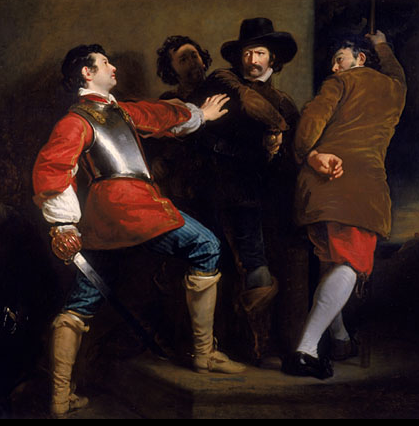
Capture of Guy Fawkes

The Discovery of the Gunpowder Plot and the Taking of Guy Fawkes” (Wikipedia, public domain).

Nicholls, overall, makes a compelling case that from from being “unthinking [Catholic] fanatics,” Catesby & company’s plan had “pragmatic coherence” and a chance of success–albeit small–and by no means entailed the certainly of death. The 13 plotters (assisted by about 70 more men) hoped to restore Catholicism as the official religion of England by blowing up Parliament with King James I in session, kidnapping his 9-yr. old daughter Elizabeth, and declaring her Queen. They did not expect foreign (Spanish, that is) assistance and hoped (and prayed) that the still-substantial minority of English Catholics would rally, armed, to their cause. “Though long, the odds against them were not impossible,” writes Nicholls.

But there was a strong non-rational, indeed emotional, aspect to the plan: revenge against the King for his (alleged) betrayal of toleration for Catholics, as well as against the remaining Catholic nobility who had failed to stand up for their lower-class co-religionists. Catesby, according to the survivors interrogated, saw himself as an “instrument of providence” who believed that “innocent blood must lawfully flow with the guilty.” Catesby had an apocalyptic vision, says Nicholls, who “aimed at a religious upheaval”–while being at the same time pragmatic, as a profoundly “political creature.”

“To understand the Gunpowder Plot, it is thus necessary to look beyond Fawkes and his barrels…and see the enterprise for what it was, a failed rebellion. The Plot may have been the work of desperate men, but however desperate those men never really constituted the ‘idiot fringe’ of extremist fanaticism, represented in popular and much academic opinion” (p. 806).  And “if the plotters actions perhaps have a modern resonance” it is because “they regarded the destruction of Westminster as the first strike in a coup, not as an end in itself” (Ibid.).
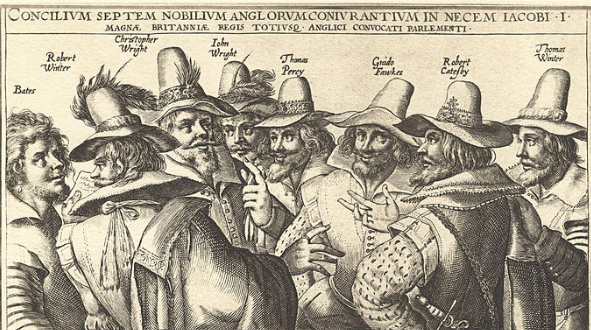
Gunpowder Plotters

A contemporary engraving of eight of the 13 conspirators,” (Wikipedia, public domain). 

I would argue that, beyond setting the record straight about Guy Fawkes and the folks he worked for, these observations about the Gunpowder Plot give us some insights into the most prevalent brand of modern religious terrorism–that of Islam. Jihadists are regularly–indeed, axiomatically–presented as an idiot, fanatical fringe who fail to understand their own religion. Just last week, after American Special Forces had chased down ISIS leader Abu Bakr al-Baghdadi and caused him to kill himself, noted Islam expert Karl Rove (is my sarcasm thick enough?) stated that the former “caliph” had “hijacked a great religion.” No, most of what ISIS does–jihad, beheadings, sex slavery of non-Muslims–stems from the Qur’an and Hadiths and can be deemed marginal only in that most Muslims do not personally engage in such activities; that, however, does not negate the fact that Islamic doctrines undergird them. And, indeed, the idea of reconstituting the caliphate is shared by a huge percentage, perhaps even a majority, of the world’s second-largest religion.

Note: I am not saying both Catholic Christianity and Islam are equally violent, but rather that commentators don’t get to define what constitutes “fringe,” based on their own personal preferences. So in the same way that historians have tended to scorn the Gunpowder Plotters as irrational and hopeless, modern analysts have made a cottage industry (as per Rove, above) of purporting to explain how even scholars of Islam, such as the houri-meeting former caliph, cannot seem to understand they belong to a peaceful religion. Large numbers of Muslims in many places also support shari`ah (Islamic law), ulama (religious leaders) involved in politics, and polygamy (as per Pew, 2013); at the same time, large minorities believe in the Mahdi’s imminent return (as per Pew, 2012)–each of these a staple of alleged hijackers of Islam such as ISIS.

At root, it’s quite plausible to see the ubiquitous phenomenon of growing Islamic fundamentalism and violence as a rebellion against the global order that the West imposed beginning in the 16th century. Whether that will fail, as the much smaller in scope 1605 one did, remains to be seen. But until then, expect plenty of gunpowder to be expended in the process.

(To see folks in Fawkes masks and kaffiyahs, and read a bit about how the trope came to the Middle East, take a look at this article from 2016.)


Apocalypse Row: Must Shi`is Fight Like It’s The End Of The World?

For most of this millennium–going back to writing my doctoral dissertation on Mahdism and Islamic eschatology at Ohio State in 2000-01–I’ve argued against the conventional (conservative and Evangelical Christian) “wisdom” that the leadership of Iran wants to start a regional, or global, war in order to usher in the appearance of the Twelfth Imam al-Mahdi. This claim that the ayatollahs want to “hotwire the apocalypse”–probably with nuclear weapons–comes from either a vast ignorance, or a profound (and probably intentional) misrepresentation, of Twelver Shi`i theology.  Maybe both.

I won’t reiterate the entire argument here. See my 2011 paper for the Institute for Near East & Gulf Military Analysis; my book Ten Years Captivation with the Mahdi’s Camps (particularly pages 103ff.); and my recent article “Do Iran’s Leaders Want to Hotwire the Apocalypse?

But am I wrong? Two months ago a member of the Islamic Republic of Iran’s Assembly of Experts (which, at least on paper, is charged with choosing that system’s Supreme Leader), Ayatollah Mohammad Mehdi Mirbagheri, gave an interview on Iranian TV and stated that “we will never reach the age of the reappearance [of the Mahdi] unless we go into widespread fighting.” On its face, that certainly appears to vindicate the idea that the heirs of the Safavids believe holy violence will help persuade Allah to release his chosen one to take over the world.

Jamkaraninside

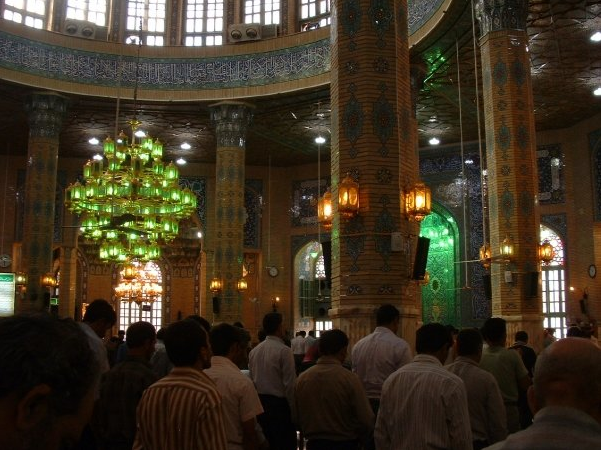
Shi`i men praying in Jamkaran Mosque, Qom, Iran, during my 2008 visit.

But it’s not that simple. See two relevant publications of mine: “Appearance or Reappearance? Sunni Mahdism in History and in Theory and its Differences from Shi`i Mahdism” (in Imam Mahdi: Justice and Globalisation, Institute of Islamic Studies-London, 2004, pp. 113-131) and “Through A Glass Darkly,” the conference paper which I presented in Tehran in 2008 (and which the Iranian government took and published as its own, here).

In both of these I delved into Twelver Shi`i doctrines, past attempts to reify such Mahdist teachings, and views of modern Iranian religious leaders. My conclusion was that yes, there is a strain of thought in Iran’s brand of Islam which promotes activity to persuade, if you will, Allah to unleash the Twelfth Imam. Prayer is one such activity. But creating the Mahdist state “in microcosm” is the best and most efficacious way to gain Allah’s favor in this regard.  The Islamic Republic of Iran is itself, in this view, the proffered state–the “vanguard” of the coming eschatological realm, as the rulers deem it. As I observed in Ten Years’ Captivation, pp. 91-93, this is more a case of  lowjacking than hotwiring the apocalypse.

[Addendum, 10.5.19. My good Canadian friend, math professor Dr. Rob Craigen, asked me on Twitter the difference between “lowjacking” and “hotwiring” the apocalypse. Lowjack is a system that allows stolen cars to be recovered by police, hopefully without a shootout; the term was coined as the opposite of “hijack.” Since the idea of hotwiring the apocalypse means, in effect, to hijack it–to force Allah’s hand via, in particular, nuclear weapons’ use by Muslims–lowjack is a kindler, gentler means of cajoling the Deity to advance His eschatological timetable. I came up with the idea after reading the commentary on II Peter 3:10-12 in the Orthodox Study Bible, which says that Christians can “actually hasten the coming of that day [Christ’s return],” not by force, but by “evangelism, prayer, holy living, repentance and obedience.”]

And I maintain that Mirbagheri’s statement needs to be seen in this light. The “fighting” to which he refers is a matter of Shi`is demonstrating fervent dedication to their belief in that branch of Islam’s core tenet: the return of the Hidden Imam to lead them to global dominance. At the end of the interview, that ayatollah says “the same revolutionary spirit that prevailed among the believers at the advent of Islam, during the Ashura [when Ali’s son Husayn was killed at the Battle of Karbala, in 680 AD], and following the occultation of the Hidden Imam, should prevail now.”

(According to Twelver teachings, Muhammad al-Mahdi, the last of the line of 12 Imams that began with Ali, disappeared in 874 AD but maintained contact with his followers until 941 AD, when all communication ceased. This is the occultation that’s so important in Twelver Shi`ism.)

Of course, this approach dovetails nicely with Tehran’s modern geopolitical aims, as recently trumpeted by Ayatollah Ahmad Alamolhoda, that any Islamic resistance to Israel in the region–not just Shi`​i groups (in Iraq, Lebanon and Yemen) but also Sunnis in “Palestine” and even heretical Alawis in Syria–is “part of Iran” and the “resistance.”  So rather like Vatican II’s idea of the “anonymous Christian,” Alamolhoda (who is a close ally of Supreme Leader Ali Khameini) seems to be promoting the idea of an “anonymous Shi`i.”  This is novel in Twelver thought, and needs more examination–but not this day.

No word yet on whether the Mahdi will accept these anonymous followers, once he returns. They might get cast into the fire, like us Christians.

But I think it’s clear that a close(r) look at Mirbagheri’s statements indicates that they don’t contradict my interpretation of political eschatology driving the Islamic Republic of Iran.

Whitewashing Terrorism

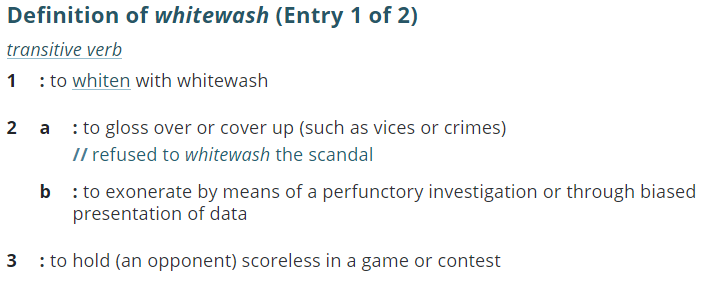
First, a quick definitional overview:

Whitewash

I’ve written before about those who employ the second meaning of “whitewash” when writing of Islam and Islamic terrorism–here, for example, elsewhere on this blog; or here, in another online venue.

But this past week I wrote a long piece for The Stream which deconstructs–demolishes, actually–the Left’s current campaign to, literally, make terrorism “white.”  It’s entitled “White Terrorists v. the Sultans of Slaughter.”  Check it out.

Of course, these aren’t the terrorists Alexandria Ocasio-Cortez is looking for–although they’re definitely white.

Rouhani Larijani Khameini

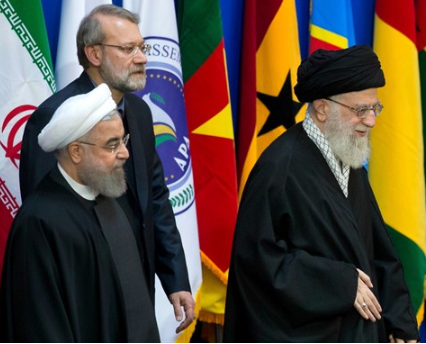
Iran’s top three leaders (credit).


The 2020 Democrat Presidential Field: Sovereigns of True Melancholy

A year ago I wrote a very long (and quite well-researched, if I may say so) post looking at Shakespeare’s plays and finding fitting analogs for both Trump and Hillary Clinton.  Since it was such fun, I did a similar one comparing the current crop of Democratic Presidential aspirants to characters in the Bard’s oeuvre. It published this past week over at The Stream, entitled “What Fools These Democrats Be.”  Check it out.  (And if you click on my photo there, it will take you to the other 11 articles of mine which they’ve run so far.)

By the way: the title of this post is from Antony and Cleopatra, Act IV, Scene 9). 

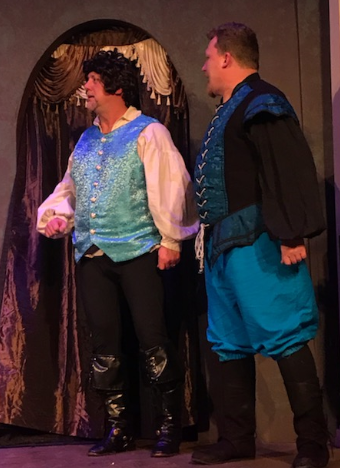
I leave you with a picture of me as Elizabethan-era highwayman Robert Middleton from the play Thee & Thou put on by the Pumphouse Players, Cartersville, GA in February 2019.  (The excellent R. Clay Thompson as the Bard himself is berating me.) And yes–that’s a wig.

MeandClayThee&Thou2019